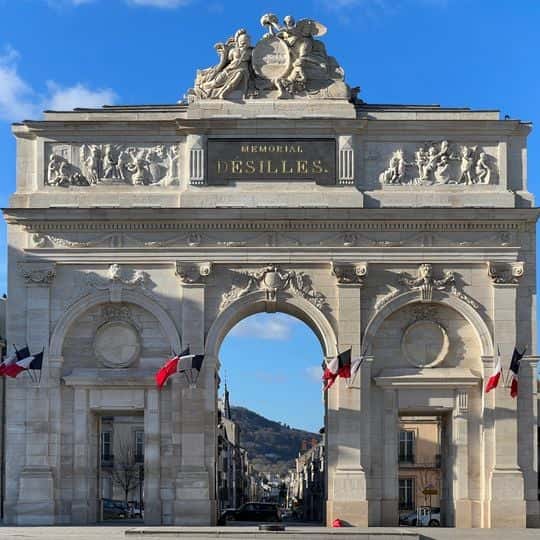
The Porte Désilles is a triumphal arch erected in 1784 at the entrance to the Pépinière park in Nancy. Its name refers to the Chevalier Désilles, a tragic figure of the Nancy Affair of 1790. The monument is accessible at all hours.
At the entrance to the Pépinière park, on the western side of Nancy, stands a triumphal arch that residents know as the Porte Désilles. Built in 1784, this monument has weathered more than two centuries of history without losing its presence. It belongs to those urban landmarks people pass every day without always stopping to look. Yet behind its stones lies a dense history, tied to the Ancien Régime, the French Revolution, and the wars of the 20th century.
An 18th-Century Triumphal Arch
The Porte Désilles was erected in 1784, during the reign of Louis XVI. At the time, Nancy was a city in full transformation. Since Lorraine's incorporation into France in 1766, the city had been modernising, expanding, and acquiring new public buildings. The triumphal arch was part of this movement. It marked one of the city's entrances and celebrated the Franco-American alliances during the American War of Independence.
The architecture of the Porte Désilles is characteristic of the neoclassical style of the late 18th century. The arch, restrained in its lines, is decorated with bas-reliefs and sculpted elements that evoke military victories and the civic values of the era. The proportions are elegant without being monumental. This is not a triumphal arch in the manner of the one in Paris: it is a monument on a human scale, integrated into the urban fabric of Nancy.
The choice of location is significant. The gate stands at the entrance to the Pépinière, Nancy's great park. It marks the transition between city and garden, between built space and planted space. It is a threshold, in both the literal and figurative sense.
The Chevalier Désilles and the Nancy Affair
The name of the monument refers to a specific episode in French history: the Nancy Affair, which took place on 31 August 1790, at the very beginning of the French Revolution. On that day, soldiers of the Nancy garrison mutinied. Tensions between troops loyal to the king and soldiers who had adopted revolutionary ideas reached a breaking point.
André Désilles was a young officer of the Régiment du Roi stationed in Nancy. When the two sides clashed, he tried to place himself between the cannons and the insurgents. According to accounts from the time, he threw himself in front of the artillery pieces to prevent them from firing. He was gravely wounded in this attempt at conciliation and died a few days later, at the age of twenty-four.
His act struck people's minds. At a time when political violence was becoming part of daily life, one man chose to put himself in harm's way to prevent bloodshed. Désilles became a symbolic figure, honoured by both sides. His sacrifice gave the gate its name, and his memory remains attached to this spot in Nancy.
A Complex Political Affair
The Nancy Affair cannot be reduced to a simple mutiny. It took place within a political context in which the French army was deeply divided. Officers, often from the nobility, remained loyal to the king. Rank-and-file soldiers were frequently sympathetic to the ideas of liberty and equality carried by the Revolution. Nancy, a garrison city, became the stage for this fracture.
The suppression of the mutiny was violent. The Marquis de Bouillé, the regional military commander, ordered troops to intervene. The fighting left dozens dead. The ringleaders were sentenced, some executed. The affair provoked intense debate in the National Assembly and in public opinion. It illustrated the tensions between the old order and the new world struggling to be born.
Désilles, in this context, embodied a third path: that of moderation, of refusing violence. It is this stance that earned him commemoration, far beyond his modest rank in the military hierarchy.
A Place of Remembrance Across the Centuries
The Porte Désilles has not only preserved the memory of 1790. Over time, it has become a place of remembrance for other conflicts. After the First World War, the City of Nancy erected a monument in the southern cemetery dedicated to soldiers who died for France. The Porte Désilles, through its function as a triumphal arch and its position at the entrance to the Pépinière, naturally became part of this memorial geography.
Today, the monument is part of the "Mémorial de Nancy" project, a city initiative aiming to connect the various places of memory and commemoration across the urban landscape. The Porte Désilles features as one of the reference points, alongside other monuments and commemorative plaques scattered throughout the city.
The Architecture Up Close
Seen from close up, the Porte Désilles reveals careful sculptural work. The bas-reliefs decorating the arch depict allegorical scenes. The themes are classic to neoclassical art: victory, peace, sacrifice, civic virtue. The figures are rendered with a certain restraint, without excess pathos, in a sober style that matches the aesthetics of the period.
The stone has aged, of course. Weather, pollution, and time have left their mark. But the structure remains solid, and the sculpted elements are still legible. The gate has undergone restoration campaigns in recent decades, which have helped preserve the most fragile details.
The arch stands on a slightly raised terrace, which gives it a presence in the urban setting. From the gate, there is a perspective along the avenue stretching before it and towards the entrance of the Pépinière. It is a pleasant viewpoint, particularly in the morning, when the light hits the stone at an angle.
The Pépinière: An Inseparable Neighbour
It is difficult to speak of the Porte Désilles without mentioning the Pépinière, the park it gives access to. This large public garden, created in the 18th century, is Nancy's green lung. It covers around twenty hectares in the city centre and welcomes walkers, sports enthusiasts, families, and couples at all hours of the day.
Passing under the Porte Désilles to enter the Pépinière is like crossing a border. On one side, the city with its buildings, streets, and noise. On the other, the park with its paths, centuries-old trees, and lawns. The gate plays its role of transition between two worlds perfectly.
Practical Information
The Porte Désilles is located at the western entrance to the Pépinière park in Nancy. The monument is freely accessible, 24 hours a day. There is no entrance fee and no visiting schedule.
The gate is within walking distance of Place Stanislas (about five to ten minutes on foot). The Pépinière park is served by the Stan public transport network. Several bus and tram stops are nearby.
To learn more about the "Mémorial de Nancy" project and the city's various places of remembrance, visit memorial.nancy.fr.