Villa Majorelle, at 36-38 Rue du Sergent Blandan in Nancy, is an Art Nouveau house built in 1901-1902 for industrialist Louis Majorelle. Open to the public Wednesday to Sunday, self-guided or guided visits.
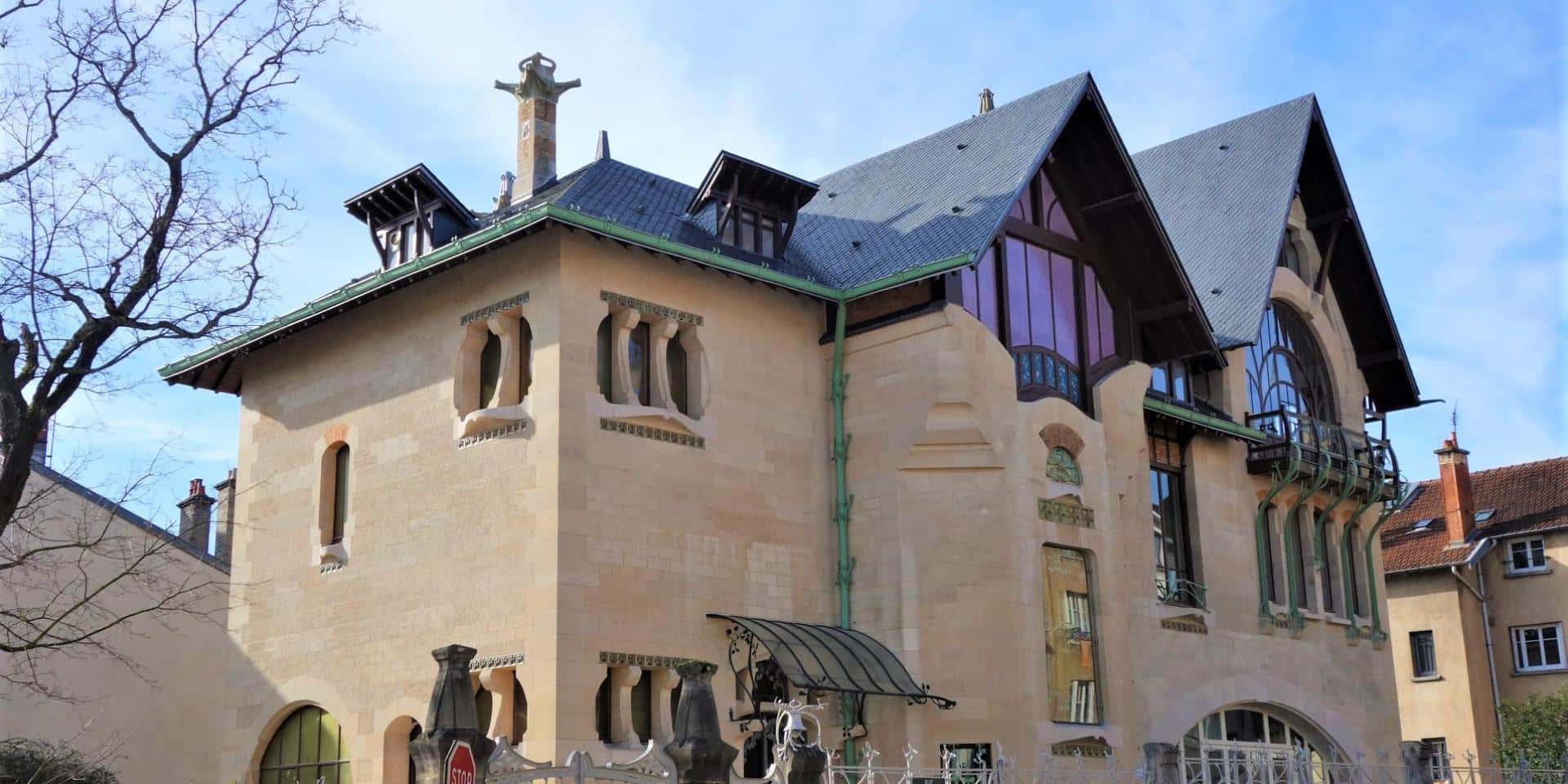
Villa Majorelle is located at 36-38 Rue du Sergent Blandan in Nancy. Built between 1901 and 1902, it is one of the few Art Nouveau houses still standing in France. It has been open to the public since 1997.
A Commission by Louis Majorelle
Louis Majorelle (1859-1926) was an industrialist and furniture designer from Nancy. The son of a furniture maker, he took over the family workshop and steered it towards the Art Nouveau style, becoming one of the leading members of the Ecole de Nancy. For his own home, he called upon Henri Sauvage (1873-1932), a young Parisian architect who was only 28 at the time.
The house was intended to embody the principles of Art Nouveau as practised by the Ecole de Nancy: unity of art, where every element of the house, from the architectural structure to the furniture, stained glass, and ironwork, forms part of a coherent whole. Decorative motifs repeat and echo from one element to the next, creating harmony between architecture and decorative arts.
Louis Majorelle did not simply commission a house. He wanted to make it a concrete demonstration of his artistic vision, a place where his furniture, ironwork, and woodwork would integrate with the architecture in an overall composition. Every room in the house bears the mark of this intention.
The Artists of Villa Majorelle
Several artists contributed to the creation of the villa, each bringing their own speciality. Construction was carried out by Lucien Weissenburger, a Nancy-based architect known for his Art Nouveau works in the city. The stained glass windows are the work of Jacques Gruber, a master glassmaker whose creations can be seen in several buildings in Nancy, including the Chamber of Commerce and Industry and the Brasserie Excelsior. The architectural stonewares bear the signature of Alexandre Bigot, a ceramist who collaborated with several architects of the period. The interior paintings were executed by Francis Jourdain and Henri Royer.
Louis Majorelle himself designed the ironwork, woodwork, and furniture of the house. His work in metal and wood is visible in the staircase railings, doors, furniture, and decorative elements throughout each room. The wrought iron, in particular, is shaped into plant forms that recall stems, leaves, and flowers.
This collaboration between architect, craftsmen, and artists illustrates the principle of the total work of art, central to the Ecole de Nancy. Every component of the house was designed in relation to the others, so that the whole forms an organic unity.
The Architecture
The villa is distinguished by its asymmetrical facade, typical of Art Nouveau. Curved lines, plant references, and the integration of materials (stone, brick, ceramic, wood, iron) form an ensemble where nature is ever present. Floral motifs appear on the facade stonewares, in the stained glass, on the balcony ironwork, and in the interior woodwork.
The interior of the house retains much of its original decor. The rooms are organised around a central hall, which distributes natural light and connects the different living spaces. The woodwork, stained glass, and ironwork elements create a decorative continuity from one room to the next. The dining room, the sitting room, and the study are among the best-preserved spaces.
The treatment of light is a notable feature of the villa. Jacques Gruber's stained glass windows filter the outside light and cast coloured reflections into the rooms. The orientation of the windows and the placement of the stained glass were designed to create different atmospheres depending on the time of day.
Note: the bedroom is temporarily closed for restoration.
Visiting Villa Majorelle
Visiting Villa Majorelle is self-guided, lasting approximately one hour. Information in French and English is available in the rooms. A trilingual app (French, English, German) accompanies the visit and provides detailed commentary on each space and decorative element. Free activity booklets are offered for children, enabling them to discover the house in a playful way.
Protective booties are required during the visit, to preserve the original parquet floors. These floors, designed by Majorelle, are an integral part of the decor and deserve observation in the same way as the furniture and woodwork.
Guided visits are offered on Saturdays and Sundays at 11am, in French, lasting one hour. The guide provides details about the history of the house, the techniques employed by the different artists, and the context of the Ecole de Nancy. Group visits are possible from 10 people, by advance reservation.
The Ecole de Nancy
Villa Majorelle belongs to the broader context of the Ecole de Nancy, an artistic movement born at the end of the 19th century. This movement brought together artists, craftsmen, and industrialists around the idea that art should be integrated into daily life. Furniture, glasswork, ceramics, architecture, and graphic arts were conceived as a whole.
Among the figures of the Ecole de Nancy were Emile Galle (glasswork and furniture), the Daum brothers (crystal), Eugene Vallin (furniture and architecture), and Victor Prouve (painting and decorative arts), in addition to Louis Majorelle. These artists shared the idea that nature should serve as the primary source of inspiration, and that plant motifs, organic forms, and curves could be applied to all objects and all spaces.
The Musee de l'Ecole de Nancy, located not far from Villa Majorelle, also on Rue du Sergent Blandan, presents the collections of this movement in a former property surrounded by a garden. The two visits complement each other for understanding Art Nouveau in Nancy. The museum displays furniture, glasswork, ceramics, and decorative art objects that illustrate the output of the Ecole de Nancy artists.
Nancy and Art Nouveau
Nancy is one of the European cities where Art Nouveau has left the most traces. Beyond Villa Majorelle and the Musee de l'Ecole de Nancy, the city has numerous Art Nouveau buildings, facades, and interiors, visible as you walk through the streets. The Chamber of Commerce and Industry, the Brasserie Excelsior, the buildings on Rue Felix Faure, and the Saurupt quarter all attest to the strength of this movement in Nancy at the turn of the 20th century.
Art Nouveau discovery tours are offered by the Nancy Tourist Office. These routes allow you to spot the most notable buildings and understand the evolution of the style in the city. For those interested in architecture and decorative arts, Nancy is a leading European destination.
Practical Information
Address: 36-38 Rue du Sergent Blandan, 54000 Nancy
Phone: 03 83 85 30 01
Opening hours: Wednesday to Sunday, 10am to 6pm. Closed Mondays, Tuesdays, and public holidays.
Guided visits: Saturdays and Sundays at 11am (in French), duration 1 hour.
Group visits: from 10 people, by reservation.
The villa is located near Nancy train station and the Musee de l'Ecole de Nancy. For updated visit conditions and any exceptional closures, information is available on the official website.